May 18, 2022

A Love Letter to Nachos

Dear nachos,

There are few things in life that bring me as much joy as food. Food is nourishing, food supports my lifestyle and activities, food energizes my body and mind.


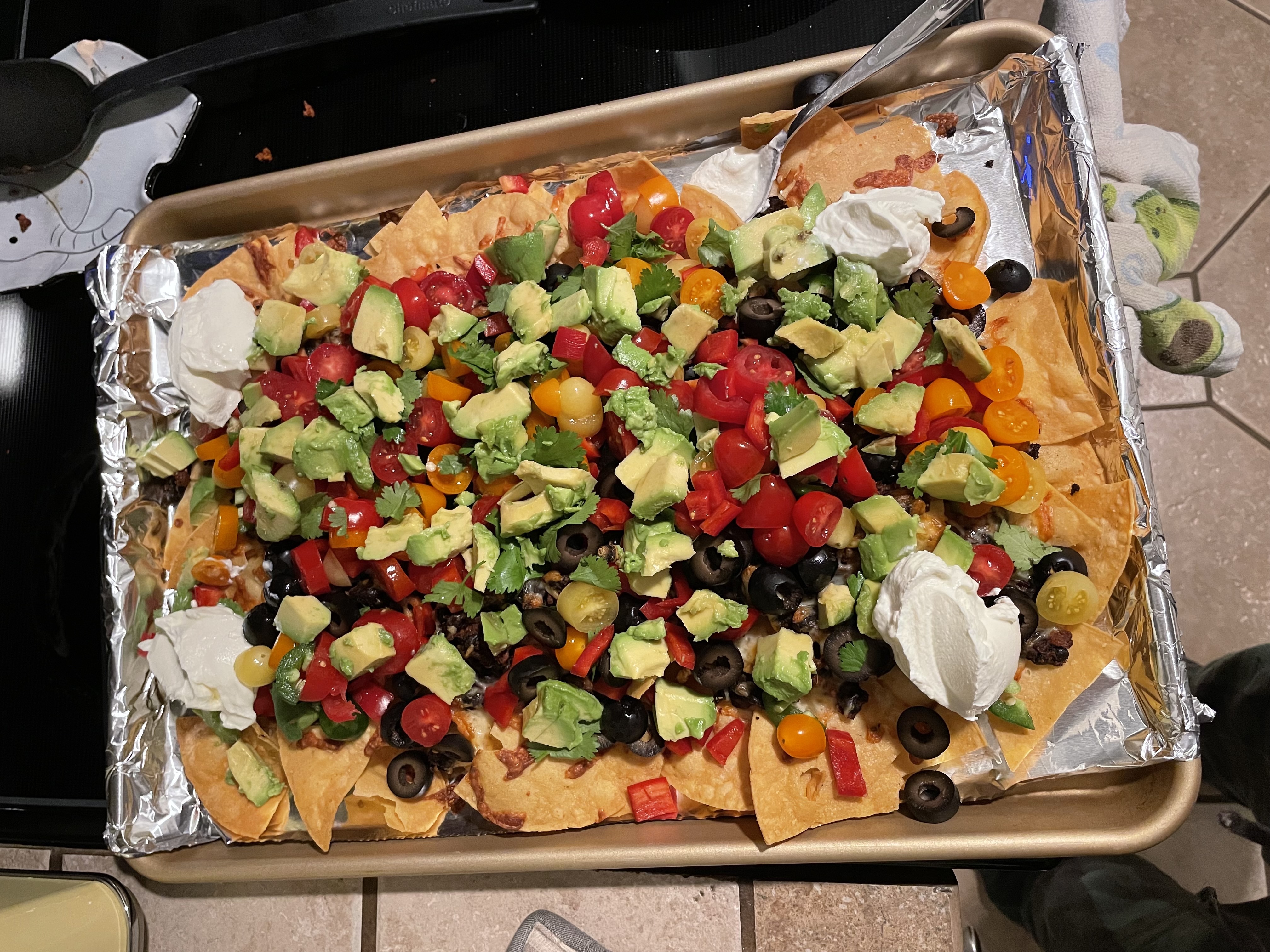
But not all food is nachos. And not all nachos are my nachos. Nachos are pure joy in food form. Sure, my nachos are piled high with sliced tomatoes, black olives, bell peppers, jalapeño, cilantro, and avocado, all of which are quite nourishing and healthy. My nachos also use home-cooked black beans and soy chorizo (same taste, less grease, no pigs). Even the cheese has nutritional value. In fact, the only unhealthy aspect of nachos are the chips.


Multicolor tomatoes, red bell pepper, green jalapeño, and black olives make nachos sort of nutritious.


Chips, and the genuine mountain of nachos. The absurd quantity is definitely not healthy. My nachos begin on a cookie sheet lined with foil, chips spread from end to end, and everything else layered on top. Nachos bring me more joy than the sum of its parts. Nourishment is not why every other Wednesday is nacho night.


I fully understand and appreciate (and, if I’m honest, pity) that many people have strained relationships with food. Many must see food as nutrition only, certainly not as a reward. Others are uninterested in food, seeing it only as a way to keep their bodies going. One person even told me that eating is a waste of time and it’s too bad that bodies need food. Far too many people are unskilled at making food and depend on re-heating and take-out. Some go so far as to forget to eat when they are busy or stressed. For a year and a half, I lived with someone who had such a difficult relationship with food that she ate the absolute bare minimum required to stay alive and not a molecule more.


Side view of nachos piled high.
Nacho mountain!

But to me, food is love. Eating food I love is self care. Making food is how I show love for others. One of my greatest joys is cooking and baking for others. Yes, I relish the enthusiastic praise for my food gifts, but I equally love gifting food when I don’t have the opportunity for praise. It’s a gesture of appreciation and community.


Food is also how I accept love from others. I have frequently told my husband that it’s his job to feed me (a task he takes seriously to ward off my hanger). I long for a dishwasher and don’t love the task of cleaning up after meals, but sitting down to a home-cooked meal he prepared makes me feel loved. Same when he buys take-out, double when he treats me to a coffee or brings home cookies from our favorite bakery. Similarly, there’s a reason we don’t get sushi take-out. Sitting at the table with friends, sharing drinks and appetizers, and swapping pieces of our rolls brings us closer together. Eating together is an act of love.


Cooking and baking are my creative outlets. I sprinkle massive flakes of finishing salt on my chocolate chip cookies to enhance the flavor of the chocolate and make them fancier. I enjoy trying new cake recipes in search of the one perfect cake, practicing my frosting skills, and experimenting with recipes to make them my own. My nachos are art. We call layering the rainbow of veggies over the baked tray "decorating". Because it is. They are as pretty to look at as they are delicious to eat. Well, almost.


"Decorated" nachos piled with avocado, cilantro, and all the other veggies.


My nachos are why I can’t order nachos anywhere else. I’m a nacho purist. Some might say I’m a snob. My food opinions are strong and unyielding, especially when it comes to something I’ve perfected. The best compliment I’ve ever received was that my food opinions are to be trusted. My nacho opinions are:

  • Cheese sauce does not belong on nachos (the only cheese we use is pepper jack)
  • Jalapeños should be fresh, not pickled
  • Chip structure and integrity is everything (we have a Costco membership almost exclusively for the toddler-sized double-bag of tortilla chips)
  • Nachos are not a vessel for hot sauce  (hot sauce it up, but don't drown them... oddly, we use sriracha)

Yet nachos are infinitely customizable. Sometimes we add sour cream. People can put meat on their nachos. Nachos can pay homage to other cultures and accommodate dietary restrictions. They're naturally gluten free! The advances in meltable vegan cheese means they can even be vegan now!


Chips, cheese, beans, and soy chorizo on a foil lined pan in the oven.
Cheesy baked nachos with black beans and soy chorizo.

I’ve written about nachos for a college paper, preached my nacho opinions to anyone who will listen (or at least humor me), invited friends to share in nacho night, and moved nacho night when other obligations have meant we would not be able to fully enjoy the experience. On nacho night I lovingly craft each chip with each ingredient for the perfect bite. I hope my last meal is nachos.


When the rest of the world has gone to utter shit, nachos are the bright light that make me forget, for an hour, that there are so many things I can't control or influence, so many wrongs I can't right, so many mistakes I've made. For that hour everything is OK because I have my nachos.


Nachos with veggies and sour cream.
Sometimes we add sour cream to nachos if we have it.


Nachos, you are perfect and I love you.


February 26, 2022

My Postmodern Family

The nuclear family never appealed to me. Even when I was a kid, turning into a teen, imagining my adult future, the mom and dad and two kid household wasn't something I dreamed of. For a long time I assumed I'd get married and have kids, because that's just what you do. The message about choice I got as a young woman in a conservative town was after getting married and having kids: to work or not to work. Presumably I'd go to college (something my parents never actively encouraged) and work for at least a little while, then also presumably I'd leave the workforce for at least a little while to raise my kids. Only then did my ability to choose my future begin: I could choose to be a stay at home mom, like mine was, or I could choose to return to my chosen field.

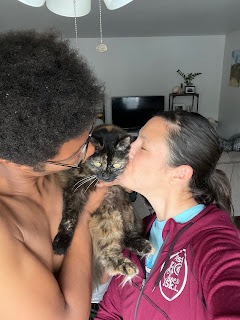
Two people kissing a cat.
Our family: Chloe at the center.

My first two boyfriends were insistent that I be a stay at home mom. It's better for the kids, after all, if a parent raises them, and naturally women are better caretakers than men so it just makes sense for the mom to stay home. Sure, they would have to work long hours to make that happen but it'd be so worth it, you know? Me, home with a couple little screaming poop machines all day long, rarely seeing my husband, being a nice, dutiful little housewife.

I noped out of that even then, to my boyfriends' frustrations. While they romanticized traditional gender roles, also having grown up in a conservative town (interestingly, one had the very traditional nuclear family and one did not, yet they both idealized it), I feared it. Maybe I'd have kids but I would not under any circumstances leave work for longer than necessary. I told one of them that if they wanted a stay at home parent household they were welcome to stay home. He laughed. The man raising the children was that ridiculous.

It was in between those two boyfriends that I first realized that the choice I had wasn't to work or not after kids, but whether to have kids at all. Or even whether to get married. It just never occurred to me, and was certainly never presented as a choice. We say "when you have kids", not "if you have kids," like a person's future children are inevitable.

This is frustrating and needs to change, but what's bothering me now is the prevalence of the traditional family at work. And somehow both the parents and the non-parents feel slighted.

Two rabbits eating pellets out of a hand.
People can understand cats and dogs as "part of the family" but anything else isn't as acceptable.

First, the parents. The pandemic has revealed just how hard it is to be a parent in America. Back in the 1940s when the term "nuclear family" first appeared, women had only just entered the workforce. Working women were supposed to be temporary, just to support the economy during WWII when so many men were absent. But some of them liked working. A lot, actually. And for a bit the economy still needed the labor of women so they were allowed to continue earning an income. Women never really went back home. Not fully. Though I'd be willing to bet (I didn't research this) that a lot of women worked part time for a few decades. After all, the household chores and childrearing still needed to happen, and our war hero men were certainly not going to do it. This mentality is, sadly, still prevalent today, as is the myth that women are better caretakers (hopefully my previous boyfriends have unlearned this) and are better suited to raising children in the home.

By the time women entered the workforce in large numbers, the 40-hour work-week was standard. It was even law! An eight hour day resulted in more productive workers, more workers for round-the-clock schedules, maximum productivity, and low unemployment. But the 40-hour work-week wasn't designed because it benefitted the worker, it was designed because it benefitted the employer. If you run a 24-hour operation and had two sets of employees working 12-hour shifts, they'd burn out between the 8 and 10 hour mark, and you'd be paying for the other 2-4 hours but not getting the same level of production. But if you hired three sets of employees working 8-hour shifts, you're still paying for 24 hours of labor but getting so much more out of those workers. It was just math. Employers didn't care who was taking care of the dishes or the kids, they just wanted production. I'm not sure where the "8 hours for labor, 8 hours for sleep, and 8 hours for leisure" saying came from, since your (unpaid) lunch break, commute time, overtime, and prep comes from either leisure or sleep.

The pandemic opened a lot of eyes to the unsustainable nature of our current labor setup. I won't go into the hardships that parents have had these last two years except to summarize that parents lost their external support but still had to keep up their jobs. In a global pandemic and period of increased anxiety and tension. No wonder so many people left their jobs.

The ones that stayed feel at a disadvantage to non-parents. Us non-parents can veg on the couch or sleep more or take additional risks for old pleasures like vacations and eating at restaurants because we don't have little unvaccinated creatures with still-growing immune systems to worry about. We can sleep through the night, probably. We don't have to juggle virtual classes and mommy can you open this and sibling fights and where did your pants go get out I'm on camera and can I go play outside while working at the same level as before the pandemic. It's fully justified, I don't know how parents have any sanity (I mean, I wonder that in general but the last two years have validated my childfree-ness in a way I never thought possible).

Three rats cuddled together in a basket.
Most people have a hard time understanding rats as pets.

But now, the non-parents, who also feel slighted. The struggles of parents are so obvious. Parents are shouting about them, bringing up their pain at every opportunity because if they don't they will burst. Some might legitimately explode. Before, comedians made jokes about stay at home moms (something something it can't be that hard of a job if you can do it in your pajamas) but no one is making those jokes now. Even for women who aren't also working. 

But we're about to start our third year of the pandemic and pretty much everyone is over it. We're tired of masks, tired of restrictions, tired of being judged for going out, tired of being judged for staying in, tired of hearing about how tired everyone is. So the plan is currently to pretend it's over. We never stopped working at full capacity, we just had to do it from our kitchen tables or couches or bedroom dresser or laundry machine (or you were a teacher or healthcare worker or "essential worker" and had to risk your health every single day). It's too much to start a third year of acute awareness of these very obvious problems, so we're just going to sweep our problems under the rug.

And non-parents, who have been keeping up when our parent colleagues had sick kids or zoom lessons or needed a mental health day (for those who are lucky enough to have compassionate employers), our struggles are not as obvious. We've been too afraid to voice them because we know we don't have it as bad as the parents and we don't want to look like ungrateful assholes for saying we're also tired and burned out. However, in this soon to be third year of the pandemic, our struggles haven't gone away, either. We've picked up the slack and kept our mouths shut, and any time parents are given the understanding and compassion that they fully deserve we wonder if our efforts will ever be recognized. 

Maybe it wouldn't have been important to recognize our efforts if the pandemic was over in a year. We were so ready to pitch in and help because of the blindingly obvious horrors of being a pandemic parent, but we are burned out. We are exhausted. We are over it. And we're feeling slighted.

A cat laying on a rug, a rabbit in the background.
My kids.

When both parents and non-parents are feeling like our employers give preferential treatment to the other group, the problem is with employers. Parents should be given the additional understanding and compassion, but when non-parents are working extra hard they should also be rewarded. Or at least acknowledged. Where I'm working, we're still operating under the pandemic structure for performance evaluations, which makes it extremely difficult to get any sort of raise or promotion. But how long are we going to operate like this? How long will "due to the pandemic" be the excuse for leadership to continue not recognizing effort?

It's also making me realize how atypical my family is. Along with saying "when you have kids", we also say "start a family" when we're trying to have a kid. When we say family we really mean nuclear family: one mom, one dad, and at least one biological kid. Americans are starting to be more accepting of same sex families, blended families, extended families, mixed-race families, and other non-traditional family structures. But they all have kids. "Family" still means a parent figure and at least one child. It does not mean, for most, husband and wife. Which is a pretty significant bummer when I think about it.

I started my family almost 9 years ago when husband and I moved in together. I considered us a sort of blended family: him and his dog, me and my cat, then we got our bunnies. Our family became more official when we got married. But since we're never having children, some people will never see us as a family. I've been thinking of my family more lately. All my babies have four legs and hair all over. They are all old, and we've already lost some. When Argo's cancer diagnosis was terminal, I told husband that this would be the most difficult thing we ever go through together. And it was. It will be more difficult than losing parents, friends, siblings, and any future pets. Last year our old bun Gandalf died suddenly, as did one of our rats. One rat is not doing well at all and Chloe has gotten a couple of worrying diagnoses recently. We know our time with all of them is very limited.

I feel like I shouldn't talk about this, especially not at work. Most of my colleagues who have pets also have children, and once you have biological children you don't see your pets as your babies anymore. And only one other person on my larger team has more pets than I do. My direct supervisor has neither pets nor kids (nor partner) and kind of doesn't understand them. (Side note: He mentioned wanting to get a cat but is "kind of worried about taking care of it that much". He also shared with me that a friend can't go on vacations or go out anymore because their dog is old and, having been in that situation, I wanted to yell at him... Also, this was mid-pandemic so vacationing and going out shouldn't really be the fun metric you judge your friends by, but things have returned to normal for him.) I do my best to schedule vet appointments and other life necessities for late in the afternoon when he won't notice I'm not online because I feel... atypical. Not understood. My family isn't taken seriously. I even recently got the "you're next for maternity leave" half joke for the first time in a really long time.

Two people in tiki decorations holding a cat and a parrot tiki glass.
We take family portraits at the holidays just like other families.

It's not just having pets instead of kids. Sometimes I forget that even though we're in a traditional heterosexual marriage, being interracial still has implications. Even in our very liberal little neighborhood (in a purple-ish city in a blue state). We live a pretty white life. I don't notice, and sometimes choose to ignore, looks in public. When we do step into Black spaces I feel welcome but a little like I'm intruding. There are online meet up groups for Black people (runners, artists, etc.) and for women, but what about mixed race couples? If husband wanted to join a Black runners group, for example, I wouldn't feel comfortable joining even if I was welcomed, just like he wouldn't join a women's running group.

So between my interracial marriage and my childfree-ness, I've been noticing how different my family is. I had to Google what the opposite of nuclear family is and "postmodern" was my answer. It includes childless couples, unmarried parents, extended and blended families, and anyone who considered themselves part of a family, regardless of blood or marriage. I guess if my availability and effort as a non-parent is going to be taken for granted, it might be nice to have the family I do have recognized.


February 20, 2022

Marriage Inequalities


San Diego skyline and ocean view from a boat.
San Diego skyline view from a whale watching tour during our staycation!

Husband and I recently celebrated our second wedding anniversary with a full week off of work. We somewhat strategically selected a wedding date that would guarantee a day off work for a couple of years (and since we got married on a Friday we had three days post-wedding before we had to respond to professional responsibilities). Also somewhat surprisingly, in all the time we had been together we had never had a staycation. We chose to do that this year for our anniversary because of covid (even spending one night out would have been highly expensive and not necessarily been enjoyable with all my pandemic anxiety) and because I'm very hesitant to leave the cat right now (my lady is at least 16 and going through old lady medical issues).

What I'm perhaps most surprised by is how much I loved our staycation. From Sunday to Sunday, we visited the Safari Park (where we met), the zoo (where we formed our friendship and cemented our relationship), had many of our favorite foods, had a movie-marathon day, went whale watching (which had been on our list for many years - and ended up seeing dozens of whales, dolphins, and sea lions), and had beers with friends. We decided we'll take a full week off every year from now on, and if traveling somewhere isn't feasible for whatever reason a staycation will be just as fun.

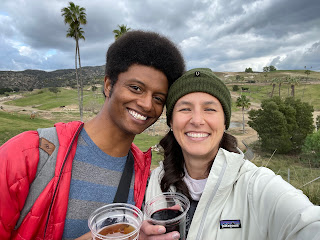
Drinks overlooking where we (kind of) met.

Husband mentioned a few times the last two years how he's treated now that he's married, and each time it took me off guard. I didn't really realize why until the last week or so. Being a man, husband is given some additional respect when he mentions being married or having a wife. Apparently, people see men who are married as more responsible. As opposed to having "just" a girlfriend, having a wife means a man is stable, that someone (a woman) has decided that he is worth marrying, and that he is worth giving responsibility, priority, and money to.

This has not been my experience. I haven't changed jobs since getting engaged or getting married, and I admit that saying "husband" gives me an air of adultness that "boyfriend" didn't (especially when among other married people). However, I have been interviewing. And I have been very careful to not mention being married. While men are free to admit to having a wife, a woman having a husband has implications that makes me, at least, hesitant to admit the situation to strangers who might otherwise give me money.

So while a man being married implies he is responsible, stable, and has long term goals that align with an employer's long term goals, a woman being married implies she is more likely to leave a job, get pregnant, and cost a company more than she is bringing in. It's illegal to not hire someone because of their marital status, pregnancy status, familiar status, etc., but it's very easy to simply not move forward with the interview process if a woman mentions anything about her husband or children or family.

Small anecdotal example: I recently interviewed for a digital marketing generalist position with a very well known company based in San Diego. The recruiter asked if I had experience in videography (which was not listed in the job description). Rather than saying "no, but my husband does and I could learn from him" or "no, but my husband does and he could be a consultant", I simply said no. I don't, after all, and they weren't interviewing my husband, they were interviewing me. The fault clearly lies with the interviewer for asking about something not listed in the job description (if you need a digital marketer with video experience you need to say so - but those are two very different jobs so good luck finding a digital marketing generalist who is also experienced in video for the salary they were willing to pay). But it surprised me that I had such a low hanging fruit right there - a person I live with who could easily help with this skill and yet I was so hesitant to admit to having that resource.

Meanwhile, my husband has relayed multiple positive reactions to him being married. Part of it is due to him appearing a LOT younger than he is. His clients are sometimes surprised that he's even old enough to be married (which just irks me to no end... dude's almost 40 and people still think he looks barely old enough to drink). But part of it is a validation that, despite his youthful appearance, he is clearly responsible enough for a woman to commit to and has to return that responsibility to her, AND he probably is as skilled as he says he is, and that his prices imply.

I also have been struggling to get the professional recognition I feel I deserve for the work I've put in the last few years, which may have nothing to do with being married. But it is difficult to feel like I'm spinning my wheels while my husband has been enjoying professional success that's at least partly related to being married, especially when he remarks to me later on how great it is being married because of how he is treated by clients and potential clients. Just... not the same for me, and I'd be willing to bet not for most women of childbearing age. 

And what am I supposed to do, mention my sterilization in my interviews and let them know I won't be leaving to bear children? That's fucked both because it's not any of their business and it puts women who do plan to become parents at a significant disadvantage.

This came up before we got married, too. When we were engaged I asked him why it was important that we get legally married, and he brought up several points. At the top were legal validation and social validation. Turns out that second one was more for him than for me. But we did experience the importance of the first one while we were engaged. My sister had a baby a few months before our wedding and we were at the hospital for the birth. The receptionist didn't question my presence but her look at my fiance was... telling. "And your relation to the patient?" she asked him. I let her know he was my fiance and she relaxed and provided him the wristband that would get him into the room.

I guess being legally married is extra important in mixed-race relationships. Just wish the gender inequities weren't so pronounced in marriage.

May 25, 2020

This Quarantine Life: How COVID-19 Changed San Diego

It's Memorial Day today and we've been staying at home for 11 weeks. I started taking photos from around my neighborhood (and sometimes beyond) to document what this time is like. I'll be updating this as I gather more photos as life changes.

Hella COVID-19

COVID-19, the new coronavirus, was associated with one of my organization's offices in the Bay Area in early March and, "out of an abundance of caution," the state chapter decided to close all offices. I had been working from home for a week already due to a cold and figured I might be home for the rest of the month. No big deal. I work from home 3-4 days a week anyway.

California recommended we keep our distance from anyone we didn't live with as much as possible. Don't go out unless you have to, shops were supposed to limit the people inside, and no gathering in large groups. The first couple of weeks were rainy in San Diego so people pretty much stayed inside anyway. Running was very enjoyable — streets and trails were empty and I had Balboa Park almost all to myself. I still went on my long runs, preparing for my favorite race at the end of March, the Hot Chocolate 15K.

Trail going through the cactus garden in Balboa Park - empty on a rainy day.

Balboa Park on a rainy day, making socially distant running easy.

30th Street in North Park - eerily empty even for a rainy day.

Then several other state chapters also closed their offices. Our bi-annual work week event (set for May, which at that time seemed far away) was cancelled. Then local and global events, small and large, and entire sports seasons were cancelled. That was surprising, but at the time we figured it was a financial decision. Then all restaurants and bars closed in California. It was a Sunday afternoon when we heard that news — they would close the next day.

Bottlecraft introduced safe shopping guidelines for picking up beer.

Pretty much immediately, I went to the bottle shop around the corner to stock up. I didn't know if they would also have to close but I wanted to get as much from them as possible, both for the variety and to support the local business. The shop employee (owner?) said they'd be open as long as possible and, since they weren't a bar or a restaurant, would probably be able to remain open (though their in-shop taps did close, as did the cheese shop in the back).

Coronavirus casualty: bringing my reusable mug to coffee shops.

I'd picked up a coffee habit during grad school, and my weekend treat was a mocha. The last one I got, when the shops were still open, had stopped accepting customer's reusable mugs. Though some coffee shops stayed open for to-go only, knowing every coffee would come with a non-recyclable plastic (or plastic coated) cup this was the end of my fancy coffees for the foreseeable future.

Husband dancing in the middle of the street on a Friday night. Our main intersection was closed due to construction but the streets were already empty.

The phrase "socially distant" was introduced. It sounded like a joke at first, like a silly phrase to get the point across. Like "click it or ticket" to get people to wear their seat belts. Man, did that phrase really turn into a whole movement. Everyone on social media was touting their abilities to go through a socially distant life while shaming those who ignored the rules.

Our last zoo visit before they closed due to the coronavirus. Still got a beer.

The zoo also announced they'd be closing with the restaurants and bars. Husband and I decided to go, one last time, and do our best to maintain distance. The zoo is all outside and walkways are quite spacious, so we did pretty well. We bypassed any area with a crowd and when a crowd did start to form near us we moved on. Husband and I had dinner that night at a latin-inspired restaurant a few blocks from our apartment. We ordered a drink, appetizers, and entrees, and the server gifted us tequila shots. The restaurant closed for good during quarantine, and that was the last we'll ever eat there.

Some retail stores closed early. Simply Local, here, put up signs.

Simply Local was one of the first stores to add encouraging signs: We will get through this together.

Things happened rather quickly after that. Or, I guess they stopped altogether. Suddenly the reason we moved to this apartment in this neighborhood — the bars, the restaurants, the shops, the social activity — didn't exist. Some shops closed completely while others attempted to conform to new regulations.
Thorn Street Brewery simply closed rather than try to work out pick ups.

Modern Times taphouse in North Park - closed.

Modern Times introduced distance beer purchases - only available if you ordered online ahead of time.

Bars could stay open for takeout only if they served food, some of which even also offered alcohol to-go. Some bars that didn't serve food also offered alcohol to-go: breweries sold cans, bottles, crowlers, and new growlers, while some regular bars canned and sold whatever beer they had in kegs. Honestly, otherwise it would have just gone bad and been dumped, and plenty of people were happy to get discounted beer from their favorite local bar. Husband and I even got a Bloody Mary from a breakfast place to-go once because why not?

Breakfast Republic celebrating the small wins - getting out of bed.

What brunch looks like in the times of coronavirus. Eggs in a box, coffee in a can, and a pre-made Bloody Mary in a plastic cup.
"We are open for take out" signs as part of a Stand Behind North Park campaign to support local restaurants.

"Thank you for your support San Diego" sign in front of Crazee Burger.

"Eat here! Or we both starve." Sign in front of Encontro.

"Take out welcomed" sign on the door of Poke One 'n Half.

Where to stand markers became common pretty much everywhere.

"Social distance saves lives" and "Keep calm and keep your distance" signs at a pizza place.

It was a bummer when our St. Patrick's day celebrations had to be virtual. A few of the bars had just put up their Guinness bunting days before closures were announced. (Some of them are still up.) I joked to our friends, over Zoom, that if we had to also spend Cinco de Mayo at home we would break into the fancy tequila we got as a wedding gift. (Spoiler alert: we did.)

Zoom gatherings became regular, and normal. My yoga studio (along with all yoga, pilates, cycling studios and regular gyms) closed and Zoom yoga replaced in-person classes.

Yoga at home is not ideal. Turns out cats love yoga mats.
Among all the cancellations was my favorite race. This year I was running with a friend so I was double bummed. The Hot Chocolate Race is the most fun I've had at an organized race and I was so excited for my friend to experience it this year. So when it was cancelled two weeks before the race date, I decided to run it anyway. After all, I'd already trained for it.

Pre-race selfie, one of us is not as excited.

My race planning skills turned out to be pretty fantastic. Beautiful daisies along the route.
A coyote! Just to the right of the white sign.

Part of my course went through Balboa Park, so I detoured through the cactus garden.

Balboa Park in the early morning.

My favorite bridge in San Diego, on Quince Street.

The coolest bridge in San Diego, Spruce Street Suspension Bridge.

I designed a new course that went along part of the real course and was exactly 9.3 miles from door to door of my friend's house. Then I baked double chocolate chip cookies, packaged up water and extra chocolate chips, and recruited husband as our race support.

Cutest race support I've ever seen!

Tiny bowls of chocolate chips to give us a sugar hit every few miles.

You can't hear the music blasting from the car radio keeping everyone's energy up.

He drove ahead to pre-planned stop locations every 2-3 miles, blasted music from his car, and gave us tiny bowls of chocolate chips with our water. Being who he is, he also took "official race photos".

Me, being who I am, decided to screenshot the race photos rather than "buy" them.

My finish line photo. Husband came up with the race name: Social D 15K.
Neighbors have been doing what they can to bring an uplifting message to others. Sidewalk chalk art usually increases in the summer but it exploded in April and May.

Best way out is through.

Hang in there!

Various uplifting messages in chalk.

Be kind, better days ahead.

You are loved.
 
I know it's hard now but it will get better. All you need is love.

Other homes took the call to be positive a little further. Some let us know in a more permanent way that things will get better.

Leaving holiday decorations up longer than usual. The sign says "Hello friends! My name is Happy Bappy!!! I am here to bring joy to all my neighbors. We can do this together!"
 
A food donation box near a closed park. "Take what you need, leave what you can. #WeAreInThisTogether People helping people"

Keep calm and carry on.

"And have fun." I'm not sure this is coronavirus-related...

"We'll get through it together" and "This is tough but so are you."

Others reminded us of our new social norms and that some things that we might think of as restrictions are actually there to help our neighbors and those more vulnerable than us. Masks became mandatory in public as of May 1st — especially in an enclosed area like grocery stores and to pick up take out —but also anytime you're out and are unable to maintain six feet between you and others.

This sign says "We can do it!! Wear your mask San Diego" using a variation of Rosie the Riveter wearing a mask.
Grocery stores and restaurants took this seriously and posted signs reminding customers that they would not be allowed in without a mask. Some bitched and moaned about this but employees (some of whom were undoubtedly not excited about working an at-risk job) didn't care. If you don't want to wear a mask you must not want groceries or food that bad.

Trader Joe's introduced new shopping rules and staffed an employee out front to check for masks.

My most negative grocery experiences were in Barons. It was difficult to introduce order in the store layout and certain customers loudly balked at the new lines.
Starting even in February certain items were hard to find. When we just happened to run out of rubbing alcohol (terrible timing, since a bottle lasts years), husband had to learn when the CVS by us was getting a shipment, go there at that time, and wait three hours while they unloaded the truck to buy a single bottle.

We've also paid closer attention to our toilet paper supply than we ever have, buying well before we need to when we can just in case it becomes hard to find again. It got so bad that many places were selling individual rolls of toilet paper, and Good Samaritans were offering up individual rolls to those in need online. Seeing the artificial shortage of many important items was really discouraging for a few weeks. As of May 25, I still haven't been able to find disinfecting wipes in any store or online (another item I use rarely but would be pretty handy right now).

Individual rolls of toilet paper rather than packs.
Stores were limiting the number of high demand items per customer but some of the limits were barely even limits. Like Ralph's limited each customer to three packs of toilet paper. Seriously, who needs multiple 12-packs of toilet paper? We were encouraged to stock up on what we'd need for the next two weeks and if people really needed 36 rolls of toilet paper for a two-week period they need to see a doctor.

"Due to high demand... we will be limiting the quantity of dry goods to 8 of the same item per guest." Super helpful, Target.

"Due to high demand... we will be limiting the quantities of toilet paper... to 1 each per guest." Still can't keep up with some people causing false scarcities for everyone else.

Other businesses made changes, too, especially churches. Mass gatherings were banned, which included religious gatherings. Smart, since I remember how much communal touching there is in churches. Many adapted.

One church offering drive-through confessions.
"Praying for our community. God is still with us."

"He is risen" sign. The church stoop is still a place where a homeless man can sleep. I felt weird taking this photo but also wondered what the churches are doing for the most vulnerable right now.

"Call for phone reading" of a local psychic. Obvious joke about predicting the pandemic.

One thing hasn't changed, at least not for husband and I. And that's take-out from our regular places. Fortunately, our favorite restaurants stayed open so we didn't have to alter our habits too much. Friday night Thai food wasn't interrupted, and neither was our tradition of almost-weekly pho.

Best Thai food in San Diego as fas are we're concerned.
Supporting our local restaurants has always been important to us. As regulars at these places, we've gotten to know the owners and staff. We're kind of friends with the owner of our favorite Thai place (who regularly gives us small gifts, such as treats from his vacations and even comped our meal when we got take out after our wedding) and want to do what we can to make sure he stays in business. We also have gotten to know the husband and wife owners of the Vietnamese restaurant we get pho from, who scaled back their business to just themselves to stay afloat. About twice a month we drive to La Mesa for a shrimp burrito from a taco stand there, which we were regulars at when husband lived there.

Pad see ew and a Thai face mask!

I'll keep updating this with more photos, as they come, especially as we ease back into whatever normal life looks like in the coming weeks and months.

UPDATE: September 23, 2020

It's been six months since lockdown started. I had an emotional break the other night. Everything had built up over the course of ten-ish days and I just needed to cry it out. The boiling point was Ruth Bader Ginsburg passing away. I just... she's been in and out of the hospital like every other month but with only a few weeks to the election I figured we were safe. It's hard to believe how much is riding on this election. What will four more years of this administration look like, even with a Democratic Senate? The attacks on the environment, the blatant support of white supremacy, the outright lies about every topic imaginable, not to mention the 200,000+ Americans who have died from COVID-19. It's overwhelming. I broke down.

Since this was originally published in May, San Diego has had multiple waves of reopening despite never making it out of the code red alert level. My best friend is back teaching and has already had to quarantine twice. Restaurants have built outdoor seating on the sidewalks and in the streets, so even walking around the neighborhood is crowded and stressful. We moved here last year excited to be closer to the bars and restaurants that we love going to, but now getting takeout is awkward and uncomfortable. We're regulars at a few places and the owners occasionally ask us when we'll be eating in. Or drinking in, at our regular brewery.

No mask = no beer at Second Chance Brewery

And we want to, very badly. Or I do, at least. The husband doesn't mind as much. I miss sushi the most, and drinking in breweries. Summer has been really hard with no sushi and no breweries. We have beautiful patios and my favorite way to spend a Sunday is to get breakfast (though my favorite place no longer exists) then have a couple beers on one of those patios.

Six months married, had beers at the park.

One good thing is that the husband is working again. After five months of forced unemployment, he opened back up (in his own studio!) in August. It was good timing, too, since unemployment payments ended in August - it would have been really tough if he couldn't work. Plus he's so much happier and fulfilled, especially because opening back up meant he can work on his side project again. And it's nice for me to have a couple of hours to myself every so often. When we said "I do" we meant forever, just not 24/7 forever.